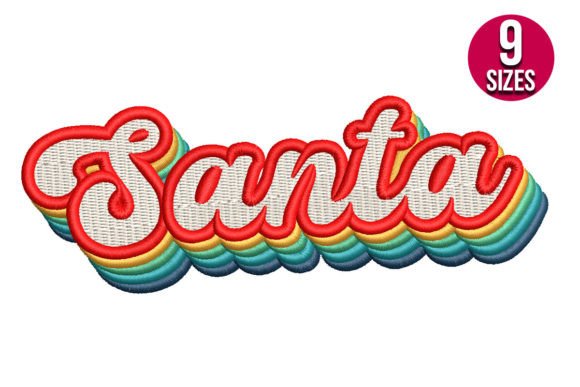
Santa Retro: A Business-Ready Holiday Embroidery Design
First Impression: Friendly, Bold, and Instantly Recognizable
As an embroidery designer who’s developed hundreds of commercial designs for small businesses, my first read on Santa Retro is immediate and positive: it’s a friendly yet bold holiday motif with clear retro styling—think mid-century color palettes, clean outlines, and expressive charm rather than fussy detail. The title alone signals approachability and nostalgia, which aligns perfectly with small business branding that values warmth, authenticity, and handmade appeal. It doesn’t feel overly decorative or “clip-art-ish”; instead, it reads as intentional, scalable, and commercially versatile—exactly what a café owner needs for staff aprons or a florist wants on seasonal tote bags.
Real-World Performance Across Merchandise Types
Santa Retro shines where many holiday designs falter: in consistent, high-impact application across diverse small business merch. As an embroidered patch, it holds up beautifully on denim jackets, canvas totes, and woven labels—its balanced proportions prevent visual crowding even at 2.5”–3” widths. For custom apparel, it works exceptionally well as a chest logo on staff uniforms, especially on cotton-poly blends common in boutique retail or bakery aprons. Its retro styling adds personality without undermining professionalism—a critical balance when representing your brand daily.
In cap embroidery, Santa Retro performs best on structured front panels (not curved bill edges), where its strong silhouette reads clearly from a distance. On tote bag design, it anchors the lower corner or center-front with confident presence—ideal for holiday pop-ups, farmers’ market booths, or local gift shop packaging. When applied to product packaging accents—like stitched tags on handmade soap or pet treat boxes—it elevates perceived value while reinforcing seasonal messaging. Etsy sellers and crafters also benefit: paired with a printable mockup, Santa Retro helps customers visualize how their handmade product will look *finished*, increasing conversion and reducing returns.
Where to Use Santa Retro Thoughtfully
Like any machine embroidery design, Santa Retro requires thoughtful placement—not because it’s flawed, but because smart embroidery is about context. Avoid scaling it below 1.75” for patches or cap fronts; fine details may lose clarity, especially if thread colors lack contrast against dark uniforms. On highly textured fabric (e.g., heavy twill or bouclé), test stitch density first—retro shapes often rely on clean line work, and excessive density can blur definition. Curved surfaces like baseball caps or tapered sleeves demand precise digitizing alignment; confirm the embroidery file includes smooth underlay and proper pull compensation before mass production.
Also consider durability: if your small business merch sees frequent washing (think café aprons or daycare staff shirts), verify that the design avoids ultra-thin satin-stitched elements or tiny lettering—neither are implied in the description, but always inspect the actual digital embroidery file. And remember: dark fabrics require brighter thread colors or white underlay to maintain vibrancy—Santa Retro’s “colorful” nature means it’ll thrive with intentional thread selection, not default choices.
How Santa Retro Strengthens Brand Identity
Holiday designs often risk feeling generic—but Santa Retro supports long-term brand identity when used intentionally. Its retro styling creates instant visual consistency across channels: a matching apron, tote, and staff cap all signal cohesive, curated branding—not just seasonal decoration. That consistency builds customer trust: shoppers recognize your business by tone and texture, not just logo placement. For handmade product sellers, it reinforces artisanal credibility—this isn’t mass-produced clip art; it’s a considered design asset that complements your unique voice.
More subtly, Santa Retro influences buyer engagement. Festive embroidery on packaging or gifts triggers emotional resonance—nostalgia, generosity, celebration—which lifts perceived product value. When customers receive a coffee bag with a crisp Santa Retro embroidered patch, they’re not just buying beans—they’re buying into your story. That emotional layer is invaluable for local businesses competing on connection, not just price.
Practical Designer Notes Before You Stitch
Before committing to production, run these checks—every one protects your time, budget, and reputation:
- Test in black and white first. This reveals spacing issues, legibility gaps, and stitch flow imbalances invisible in color previews.
- Verify patch-size performance. Resize the embroidery file to your target dimensions (e.g., 2” round or 3” vertical) and check outline integrity and internal detail retention.
- Review thread color contrast against your base fabric—especially for dark uniforms or natural linen totes.
- Inspect spacing between elements. Retro styling often uses deliberate negative space; ensure no stitches crowd adjacent areas on curved seams or narrow straps.
- Confirm hoop size compatibility with your commercial embroidery machines—and whether the design fits standard hoops without re-hooping mid-stitch.
- Test on real fabric, using the exact stabilizer you’ll use in production. Fabric texture dramatically affects stitch lay and sheen.
- Create a physical or digital mockup for client approval—especially vital for Etsy shops, boutiques, or collaborative branding projects.
- Compare Santa Retro beside your existing design assets. Does it harmonize with your logo, typography, and other seasonal motifs? Consistency starts here.
- Confirm commercial licensing before use—this is non-negotiable for small business merch, branded patches, or resale items. Never assume personal-use rights extend to commercial embroidery.
Ultimately, Santa Retro isn’t just a Christmas embroidery file—it’s a flexible, brand-forward tool for small businesses ready to stitch their story into every apron, cap, and tote bag this season. Used with intention, it delivers more than festivity: it delivers recognition, reliability, and quiet professionalism—all in one colorful, retro-styled stitch.